Pages

Subscribe:

Search This Blog

Friday, November 21, 2014

Rum, spice and Pirates.

Welcome! The following scenario is a semi-continuation of my Silk Road scenario. If you haven't read my previous scenarios please check them out, it isn't required, but highly recommended. This scenario will be covering Chugach standards 7.8 and 7.9. These standards cover “intensified hemispheric interactions” and the beginning of the Age of Revolutions.  They will cover understanding “significant ideas, institutions, people and events” from the Age of Discovery leading to the Age of Revolutions.


To demonstrate these standards we’ll be role-playing the interactions between East India Co, Britain, France and india. Following suit with my previous Silk Road RP scenario we’ll be focusing on globalization. By globalization, I mean, the act of sharing resources to the point that towns and cities can survive without local sustainability. I've chosen the East india Company as the focus because it came to be the single most powerful company involved with early world globalization, through their competition with other European trade companies.


The RP scenario will take place between the 17th and 19th centuries and focus on colonial India, and trading broader Indian ocean. Late game RPing can be adapted to new world trading and colonization, allowing for players to transition into the next set of standards involving the Age of Revolutions. Global trade during the this period fueled the power struggles between European powers. Meanwhile, in India there were several commercial players at work. Mainly this involved the Dutch East India Company, East India Company, and the French East India Company. The RP will be focused on the large scale interactions between these companies and their chartering nations.


The Dutch East India Company was initially the largest of the trading companies established in 1602, when the United States of Netherlands gave a 21 year monopoly to eastern based trade (India and Asia). Statistically the Dutch East India Company was the largest and eclipsed most other companies during it’s prime, which was the 17th century. Sending roughly a million Europeans to the east to trade and police the land they claimed sovereignty over.


tradeflows14001800.pngThe map above shows the trade routes from the 1400-1800s.


Following the Dutch East India Company, the British counterpart was formed as the closely named East India Company. This formation occurred on 31 December 1600, when they were given a monopoly charter from Queen Elizibeth of England to trade in India. The company thrived from trades of “cotton, silk, indigo dye, salt, saltpetre, tea and opium.” They eventually came to govern parts of British ruled India with a privatized army..


The French East India Company was founded in 1667- being the latest to the trading scene. After both the Dutch East India Company and British East India Company. However, the directors of the company were highly experienced, and it quickly rose to become a major competitor to the other two, although at this stage the Dutch East India Company was fading in influence.


Now to the game play! This is a unique RP that spans a large period of time, so unlike my previous scenarios we’ll be role-playing as the major companies, nations and pirates that held sway over the eastern trading routes instead of individuals as in our previous scenarios. Meaning the players will choose roles inside of companies, nations and pirates to control large portions of operations. The teacher or game master will direct the game by following historically accurate timelines and giving consequences to actions that players make.
Players are suggested to play as the following, but can choose any nation or empire related to the topic within the era.
          • England
            • royalty/govern (Rulers or political parties.)
            • navy/army (Commander of the military)
            • emissary (Emissary sent to do diplomatic reason with other nations and or companies.)
          • French
            • royalty/government ( Rulers or political parties)
            • Military (Commander of the military, see links below for detailed information)
          • Company Roles (you can choose any of the companies that were at play):
            • CEO ( Leader of the chosen company, has to follow historically accurate timelines.
            • Merchant Navy ( commands the Merchants, Receives orders from the CEO)
            • Navy (Naval commander, receives orders from the CEO)
            • Army (Commander of the armies, receives order from the CEO)


The Character Sheets will be as follows:
Character Sheet:


Name (Your character's Name, make sure to keep in historically accurate):
Age (Your characters age, keep in mind the average lifespan of people back then) :
Gender (Male or female):
Company/nation/pirate:
Position:
Skills:
Appearance (Writing up two to three paragraphs that describe your character is common):
Personality (Same as the appearance for descriptive):
Biography (Same as the descriptive for personality or appearance):


Resources:


Thursday, November 13, 2014

Rping on the Silk Road

Welcome! This is the second installment of my historic scenarios using RPG Forums. Hopefully, you’ve already read and played through my previous scenario and want to continue through history. If not, you can find my previous scenario and RPG Forums guide here. In this scenario we’ll be covering chugach standards SS 7.6- 7.7. This covers “Classical Traditions, Major Religions, and Giant Empires Era 1000 BCE- 1500 CE”. The objectives of these standards once more is to “understand significant ideas, institutions, people and events” from the period.

To demonstrate these standards we’ll be using The Silk Road as our RP’s context. The Silk Road can be considered the first act of globalization, linking trading routes between Rome and China. Leading to the centralization of culture, technology, religion, and resources into bustling trade cities along the route. I’ve chosen this as our context because it signifies the development of trade and commerce between separate nations, building demand for various luxuries, food, and art. This fueled the expansion of empires that this standard covers.

The Silk Road was first defined by an eastern emissary, Zhang Qian, who was sent by emperor Wu around 138BCE to locate the Yuezhi people. He wanted to obtain their aid in defeating the Xionghu, a local group of harassing marauders. Zhang headed west, leading him into contact with several great empires. One of these included the Dayuan, descendants of Alexander the Great’s army who had been in the region X number of years previously. When Zhang returned home and let emperor Wu know about the western lying kingdoms, trade routes between western and eastern worlds were established. Trading flourished, among the many goods that were traded none were more revered than silk. Notable technologies such as paper and gunpowder were also traded. The popularity of the silk trade led to the naming of the trade route- The Silk Road. Which was coined by Ferdinand von Richthofen, in 1877 CE, a german geographer and traveler. An image of the route can be seen here.

To successfully role-play this scenario, you’ll need to research how people traveled along the routes, to understand how to play your characters. Basically what this means is that when you choose your character, you’ll need to learn and infer about their professions, potential personality, likely ambitions, daily concerns, and life choices.

LIfe on The Silk Road:

To create your character you’ll follow a character sheet. I’ve set one up below as an example:

Character Sheet:

Name (Your character's Name, make sure to keep in historically accurate):
Age (Your characters age, keep in mind the average lifespan of people back then) :
Gender (Male or female):
Job (Merchant, mercenary, guardsmen, highwaymen):
Skills ( What skills would help your job, keep it realistic):
Appearance (Writing up two to three paragraphs that describe your character is common):
Personality (Same as the appearance for descriptive):
Biography (Same as the descriptives for personality or appearance, just read up on the life of traveling on The Silk Road):

Now that we have covered the context and character sheets, where do the role-players come in? Well the goal of the RP is to have students role-play their character as traveling merchants, mercenaries and various other traveling folk. That travel from settlement to settlement. Where the teacher who will be the important NPC’s like royalty, that give out tasks and challenges for the player to complete earning rewards. The students goal, or the goal of the role-players is to perform and complete tasks given by the teachers NPC.

Teachers tasks:
  • Assign jobs and quests to players. Aligning the quests or jobs to the role the players have chosen. So if the player is a merchant, have a local merchant guild order the player merchant to travel to another city and deliver x goods for a certain amount of money.
  • As they are traveling throw in problems that the players must deal with, making sure the problems are historically accurate (I.E bandit raid or mudslide)
Player roles:
  • Suggestions for the player roles are:
    • Merchants,
    • Traveling adventures
    • Explorers
    • Merchant guards
    • Mercenaries
Thats pretty much it, for comments and questions feel free to email me at cymeks.hun@gmail.com or post in the comments section.

Tuesday, November 11, 2014

RPG Forums scenario using The Grand Pyramid of Giza

Welcome! This is the first scenario using the RPG Forum as an educational tool. We’ll be working on Chugach’s SS 7.4 standard. This covers “early civilizations and pastoral peoples era 4000-1000 BCE.” The objective of this standard is to “understand the institutions, people and events” from this period. The goal of the scenario is to help students connect to the human side of history. By this I mean that when you study history you’re typically reading and/or watching historic events from a disconnected point of view. Creating a very impersonal learning experience, often leading to memorizing dates, events and places without gaining an emotional connection. To solve this problem I’m using the text based roleplaying found on RPG Forums to provide a simulated experience. To do this, I’ve created a set of historic scenarios that allow students to personally interact with history in a dynamic way through cooperative storytelling (you can check out my RPG Forum guide to understand what RP’s are all about).

To showcase the standard we’ll be using the construction of The Grand Pyramid as the context for our role-playing. The Grand Pyramid at Giza is seen as one of the first major events in the BCE. I’ve chosen Giza because it signifies a major advancement in human history in developing large-scale projects that require massive amounts of funding and logistical support. This achievement highlights a defining characteristic of civilizations throughout BCE, that being the ability to coordinate people and supplies toward a unified goal (willingly or unwillingly).

In this scenario we’ll be RPing during the construction of The Grand Pyramid. This pyramid was commissioned by the pharoah Khufu who ruled between 2609–2584 BCE, the construction took place south-west of present-day Cairo on the Giza Plateau. The Grand Pyramid was a project that required workers from all over egypt; bringing in artisans of stone and clay, architects, engineers, boatmen, cooks, and laborers.

To successfully RP this scenario you’ll need to access several resources to accurately play your chosen character’s roles. Basically what this means is that when you choose your character, you’ll need to learn and infer about their professions, potential personality, likely ambitions, daily concerns, and life choices.

The overarching goal of the RP is for the players to join work gangs, see “ Life of Pyramid Workers” linked below. The players will then perform jobs within the worker gangs on the pyramid, they will compete with other gangs, have internal strife, deal with issues constructing the pyramid, loss of tools and etc.

Life of Pyramid Workers:

To create your character you’ll follow a character sheet. I’ve set one up below as an example:

Character Sheet:

Name (Your character's Name, make sure to keep in historically accurate):
Age (Your characters age, keep in mind the average lifespan of people back then) :
Gender (Male or female):
Job:
Skills:
Appearance (Writing up two to three paragraphs that describe your character is common):
Personality (Same as the appearance for descriptive):
Biography (Same as the descriptives for personality or appearance, just read up on egyptian life):

Now that we have covered the context and character sheets, where do the role-players come in? Well the goal of the RP is to have students role-play their character in workers gangs that are assigned tasks from the pharaoh’s vizor who in turn receives orders from the pharaoh. These two roles will be role-played by the teacher, giving them control of the rp. This means that the teacher will place their students into worker gangs and then give those gangs historically accurate challenges, tasks and rewards based on completion speed and quality. The students goal, or the goal of the role-players is to perform and complete tasks given by the Vizor.

  • Vizors tasks
    • Assign role-players to roles ( there can be more if you wish):
      • cook
      • Laborers (actually moving blocks into place)
      • Architects:
      • Boatsmen (Transporting stone blocks)
      • leader of the worker gang
    • Set up challenges and obstacles for the gangs. Forecasting low water for the Nile.
    • Give the worker gangs jobs related to the pyramids construction.
    • Give out rewards based on historically accuracy, and completion of projects.

Thats pretty much it, for comments and questions feel free to email me at cymeks.hun@gmail.com or post in the comments section.

Thursday, November 6, 2014

Step by Step Guide on using RPG Forums

Welcome back to my step by step guide on creating your Out Of Character (OOC) thread for RPG Forums. In this post we’ll be going over the technical creation of our OOC thread and how to structurally format and write up the context for our role-play. We’ll first go over the technical creation of the thread, and then move onto a brief outline of the content needed.

Actually creating our OOC thread on the RPG Forums is fairly easy, it’s as follows:
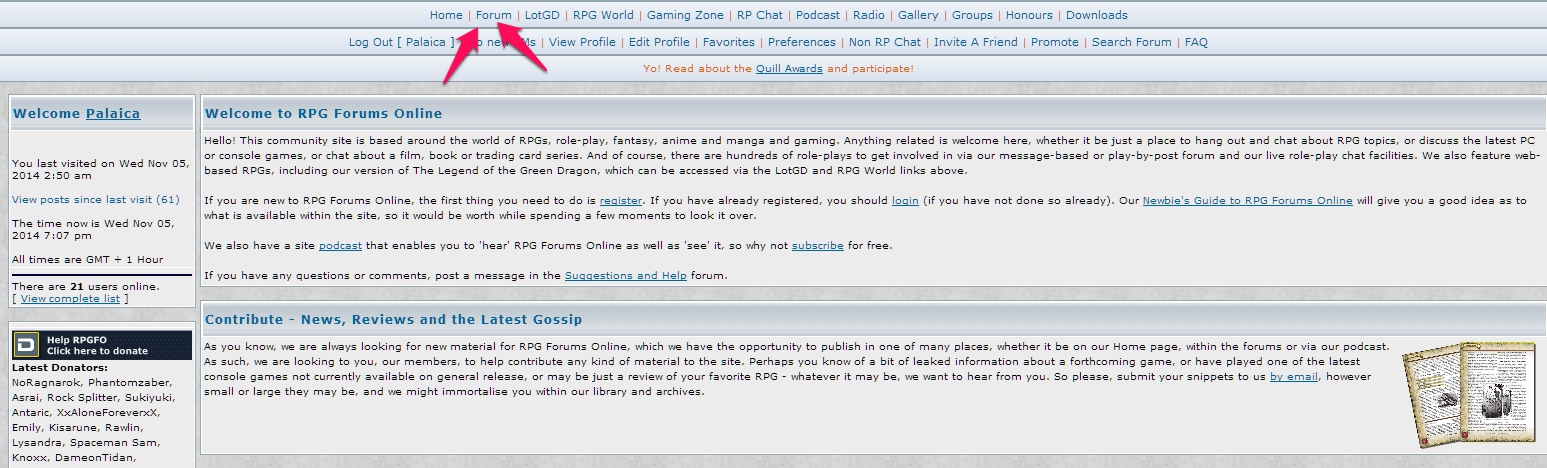
  1. Go to http://rpgforumsonline.com, once there log into the site, or if you haven’t created an account please do so now, by going here (see arrows):
RPGFO.jpg

  1. Once you click on “Register” and enter in the required information, (e.g. username, password, e-mail and birthday, feel free to fake your birthday). The site will then require you to verify your account. You do this, by going to your email and opening it up. Inside there will be a nifty link that auto-verifies for you. At this point you can now log in.

  1. Next we’ll navigate to their forums by clicking here (see arrows):
RPGFO_forum_click.jpg

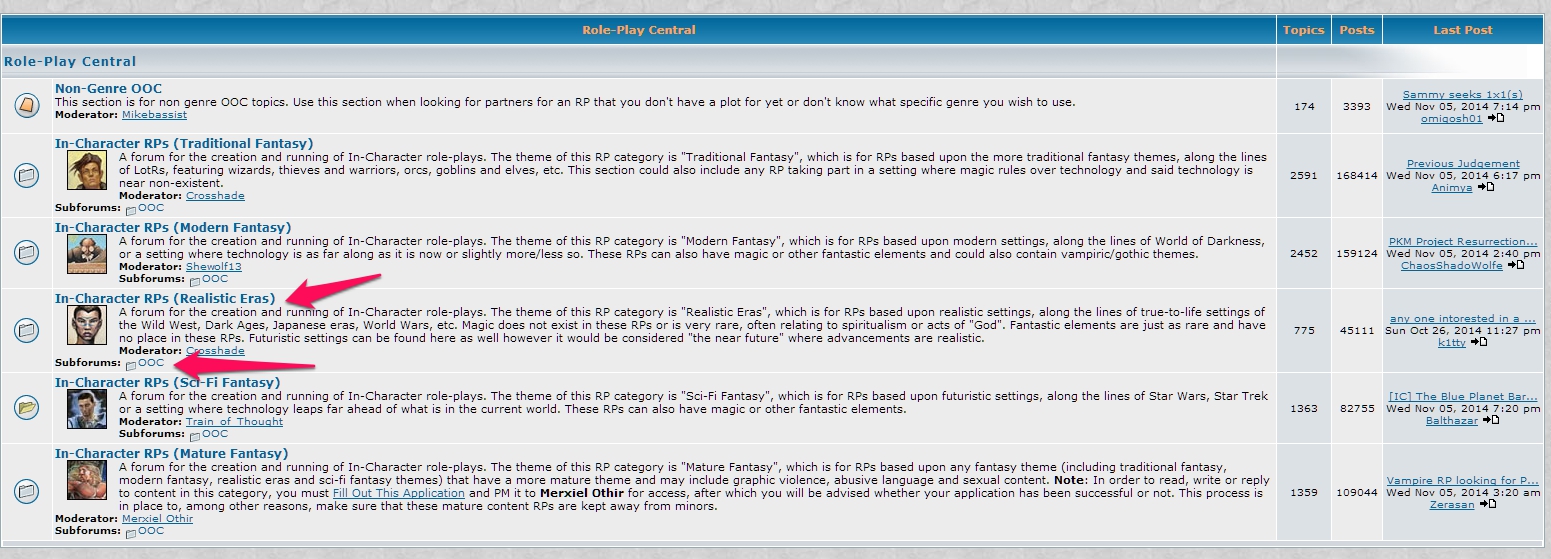
  1. That link will bring you to the RPG Forums… forum board. Once there,  you’ll have to scroll down a bit to look for the board category: “Role-Play Central,” it should look like this (see arrows):
RPGFO_RP_Central.jpg

  1. Because our goal is to role-play historical events we’ll be posting both our IC and OOC in the category “Realistic Eras”(seen with arrows). First we’ll need to create our OOC, so navigate to “Realistic Eras” OOC sub-thread (the lower arrow).
RPGFO_RealisticEras_OOC.jpg

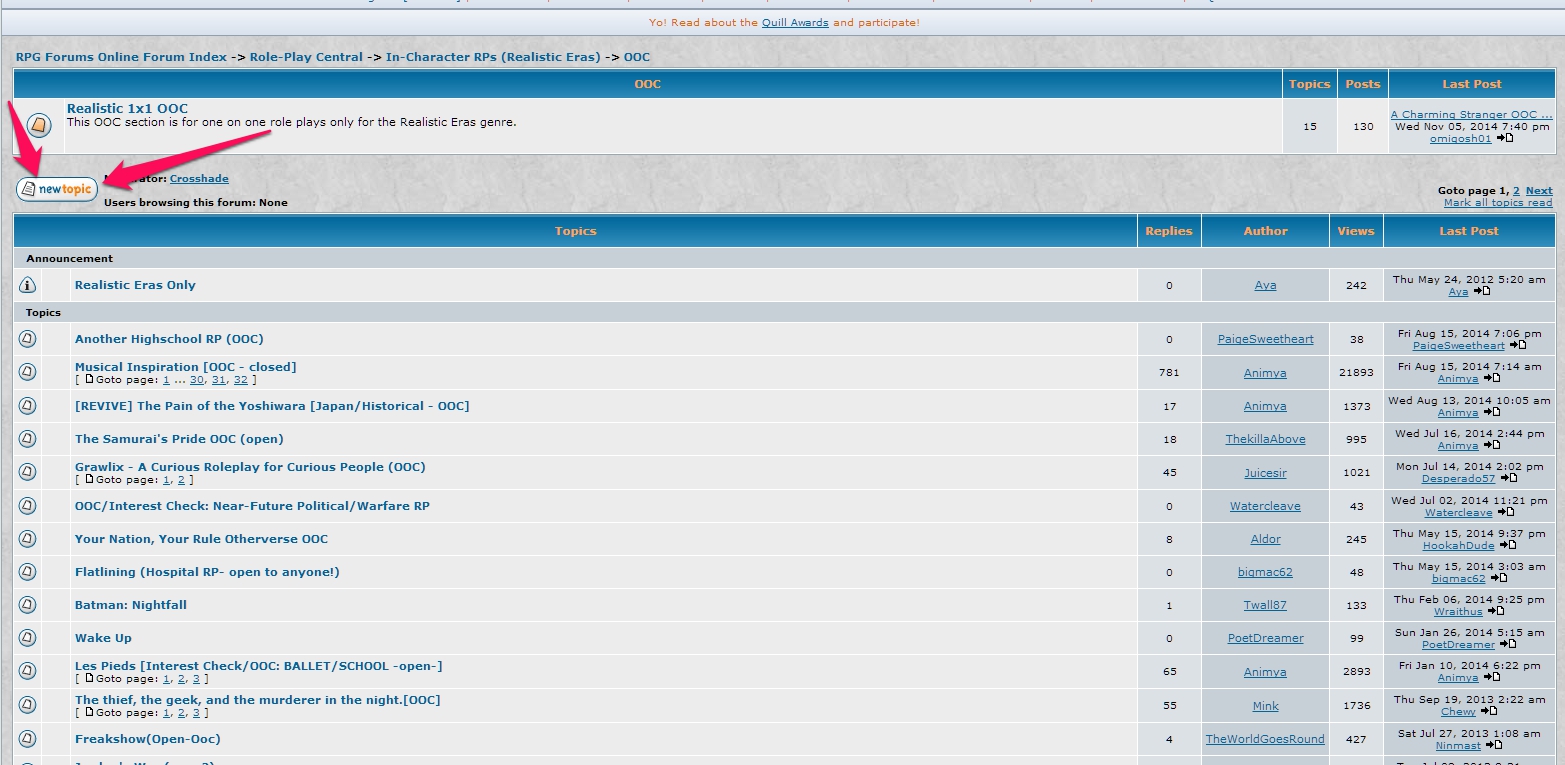
  1. Open up the OCC sub-forums, which should pull up a page like the one below. Once it’s open, you’ll need to click the “New topic” in the top left-hand corner, this will open up your editor and will allow you to create a new thread.
RPGFO_RP_Central_2.jpg

  1. To create an IC thread we’ll be repeating step 5-6, but instead of going to the OOC thread we’ll go to the IC thread (top arrow).

Now that we know the technical aspects of creating forums threads, check my series of RPG Forum scenarios. So that you can use those scenarios as content.

Sunday, November 2, 2014

Guide to Using RolePlay Forum in an Educational Setting.


Roleplaying is used in many different settings, from video games to real life. Simply put roleplaying is taking on a persona and acting out that persona as if it were you. Actors do this to make a living. A famous example of this is the fantasy dice game Dungeons & Dragons. For our purposes we’ll be using the webpage RPG Forums to participate in historical events as if they were part of them.
Since we’re using the RPG Forums as our role-playing platform there are rules and etiquette that must be followed to provide a healthy community. The sites provides an extensive list of rules, here are a few example rules are as follows:

  • The role-playing forums are split up into two different section one for out of character (OOC) and in character (IC). This means that when you’re posting in an area designated as IC you post as your character and nothing else. However, when you’re in OOC areas you don’t need to post IC.
  • Vulgarity in anyway is not allowed.
  • Do not under any situation control another person’s character (moving or making decisions for them) in IC scenarios.

Etiquette, However, is harder to learn etiquette because it is a byproduct of people’s opinions and not often written down. Although you will see personal rules posted on OOC threads allowing for others to understand how the original poster wants their thread to behave. Some common example are:

  • Writing with proper grammar, spelling and punctuation is highly preferred, but not entirely forced. Do not write using texting substitution like “U,” and “R” instead of “you” and “are”.
  • Length of posts must generally be longer than a few paragraphs to provide depth.
  • Most of the time the thread author will want RPers to post at least once or twice a week, sometimes more.

The community within the RPG Forums are all fairly honorable, but it is a public site and that is something to be aware of. However, keeping posts private is fairly easy by adding an “invite only” modifier to the title of your thread (e.g. Age of Civilization 3100 to 100 BCE-invite only-).  This tells most of the other RPers that the only way to get in is through an invite, which allows for threads to be closed to outsiders. This allows your students to share a thread that only they will contribute to, but others may still read it. The readability of the thread shouldn't be seen as a problem. The public nature is partly what always motivated me to write with a higher quality when on the site.

My next post will go over step by step on setting up a thread on RPG forums, followed by scenarios for my standards.